In A Rare Display Of Motherly Love, A Polar Bear Mom Adopts Orphaned Cub
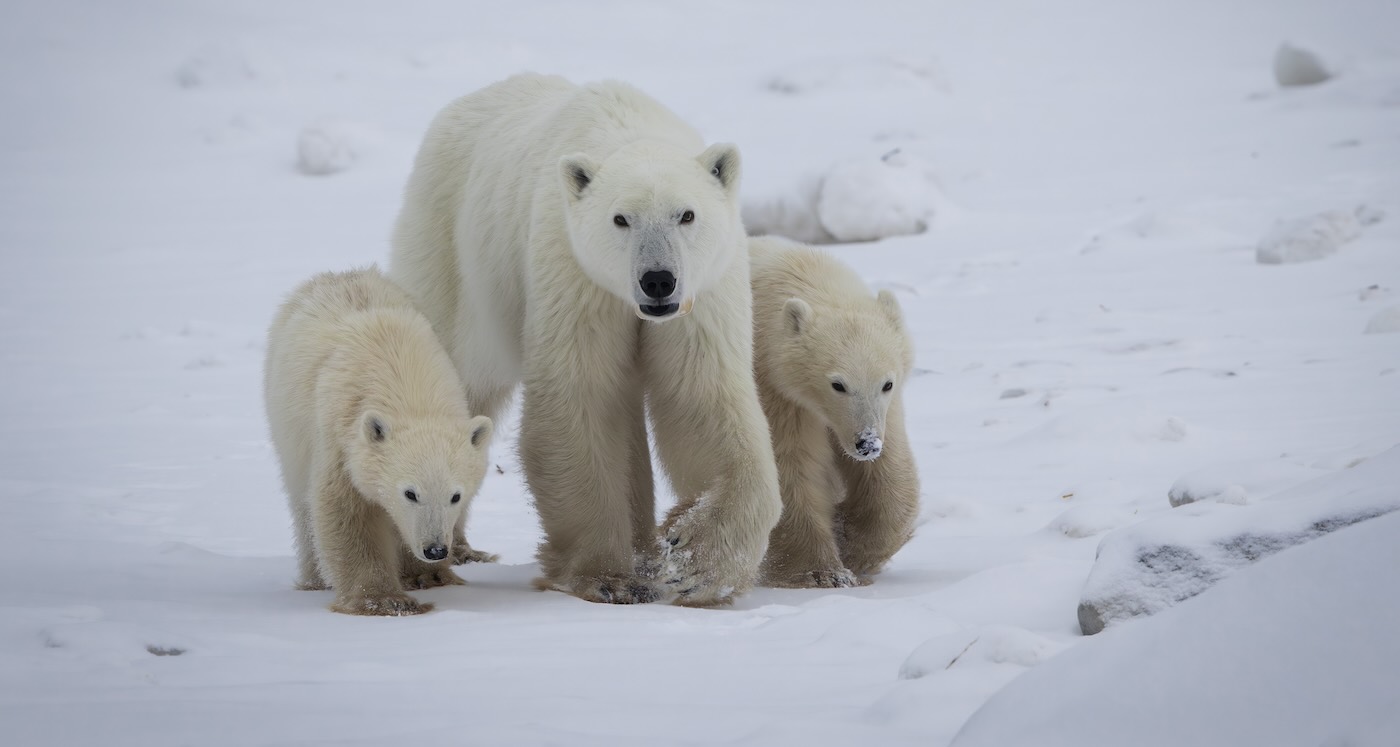
Photo from Dave Sandford
In the wild of northern Canada near Churchill, Manitoba, polar bear researchers witnessed the shocking event. It was even captured in photographs and video by Dave Sandford.
About Polar Bears
Polar bears are built for life on sea ice, but their survival depends on a harsh and changing environment. Here are some basic facts that show what makes them so powerful, and so vulnerable.
Basic facts
Here are some basic facts about polar bears:
- Largest of the bear species
- Males can be up to 10 ft tall and weigh up to 1,700 lbs
- Their fur reflects light, which makes them appear white
- Their skin underneath the fur is black
- Paws are massive and contain bumps for traction on ice
- They are strong swimmers and can swim for several days
- Live on sea ice in Arctic regions
- Mostly eat seals, but also walrus, beluga, eggs, and vegetation
- Less than 2% of hunts are successful
- They can smell prey up to 40 miles away
- Only pregnant females hibernate
- Lifespan of about 20-25 years
- Listed as a threatened species
- Affected severely by climate change
For another story about animals and the bonds they create, see Retired Police Dog Wins American Humane Hero Dog Award.
The Annual Polar Bear Migration
Each year, researchers in northern Canada track polar bears as the seasons reshape their world. Along Hudson Bay, timing, temperature, and daylight can mean everything.
Hudson Bay and seasonal shifts
Researchers in northern Canada track the annual polar bear migration. They track movement along the Hudson Bay, which is the largest inland sea in the world.
There are approximately 2,000 polar bears in the Hudson Bay, which spans nearly half a million square miles. The environment changes with the seasons.
Sea ice forms in the late fall and remains until early summer. In July, the temperature is typically in the mid-60s (Fahrenheit) and minus-10s (Fahrenheit) in January.
Canada is known for very short amounts of daylight in the winter, going from 20 hours of daylight in the summer to just 5 hours of daylight in the winter.
A Glimpse Into The Life Of A Polar Bear
The year moves in phases for polar bears, especially in Hudson Bay where land and ice trade places across seasons. This seasonal rhythm shapes where bears travel, how they hunt, and how mothers raise cubs.
By season in Hudson Bay
National Habitat Adventures describes the typical life of a polar bear in the Hudson Bay in Canada by season:
- Winter
- Females hibernate, gestate, give birth, and nurse their new cubs
- Males spend the winter on the ice, living off their fat reserves
- Spring
- New cubs are getting ready to leave the den
- Males emerge onto land to breed
- Summer
- In Hudson Bay, bears go inland
- They shelter in dugouts to deal with the heat
- Fall
- When the ice forms, it’s hunting season
- The ice is thick enough to hold their weight, so they head out to prey on seals
- They move along Hudson Bay
Motherly Love
Near Churchill, Manitoba, researchers saw something that doesn’t happen often in the wild. A young mother was moving with two cubs, and one of them wasn’t hers.
A rare adoption in Western Hudson Bay
Polar bear researchers near Churchill, Manitob,a saw a five-year-old female on the move with two cubs appearing to be about 10-11 months old. They were able to discern that only one of the cubs was her biological cub.
She was first observed in the spring once she left her maternity den. When she emerged from the den, she only had one cub and researchers tagged it for tracking.
The cub that was not biologically hers did not have a tracking tag. After careful consideration, researchers were able to confirm that this mother had adopted the cub.
This is only the 13th documented case of polar bear cub adoption out of 4,600 bears studied over a 50 year period. Polar Bears International photo ambassador Dave Sandford photographed and filmed the rare sight.
The mother may have just saved this cub’s life by adopting it. Polar bear cubs have a 50% chance of survival into adulthood, but without a mother, those odds are not looking good.
It goes without saying that the best-case scenario for survival into adulthood would be if the cub could have stayed with its biological mother. In the Western Hudson Bay population specifically, only 3 out of the 13 adopted cubs survived into adulthood.
The mother and cubs seem to be healthy, and hopefully, there will be 4 cases of adopted cub survival.
For another story centered on caring for vulnerable wildlife, see A Scotland Couple Turned Their House Into A “Hedgehog Haven”.
Reactions
For researchers and conservation advocates, this moment carried both awe and realism. The adoption sparked hope, but it also pointed back to the pressures polar bears face.
What researchers and advocates said
Alyssa McCall of Polar Bears International said, “It doesn’t happen often at all. But when we confirmed this was an adoption, it gave us a lot of hope. It’s another reminder of how fascinating and incredible these animals are.”
Dr. Evan Richardson, a polar bear research scientist for the group Environment and Climate Change Canada, reported, “Throughout over 45 years of tracking more than 4,600 individual polar bears in this Western Hudson Bay subpopulation, this is the 13th known case of adoption. The mother, known as bear X33991, was encountered by researchers in the spring of 2025 as she came out of her maternity den, and she only had one cub, which was tagged. When she was seen again in the fall, she had two cubs, one with a tag and one without. Genetic samples were taken from the adopted cub and are being analyzed to try to identify its biological mother.”
Richardson also commented on the negative effects of climate change, “The bears need all the help they can get these days with climate change. If females have the opportunity to pick up another cub and care for it and successfully wean it, it’s a good thing for bears in Churchill. It’s just nice to know that the bears are looking out for each other.”
For more on how hope and care can ripple outward, see The Science of Kindness: Why Doing Good Feels Amazing.
About The Author

Aubrey White
Aubrey graduated Summa Cum Laude with a Bachelor’s in English from Montclair State
University. She has always been passionate about reading and writing and hopes to one day
publish her own novel.
Some of her favorite books are The Silent Patient by Alex Michaelides, The Shining by Stephen King, The Midnight Library by Matt Haig, and First Time Caller by B.K. Borison. She loves animals, especially dogs. In her free time, she likes going to the gym, hanging with friends, watching rom-coms with her mom, reading, and writing short stories.




reader's monthly pick


subscribe to newsletter
Sign up for The DivsFeed newsletter to get heartwarming stories in your inbox every month.