A Legacy of Responsibility: Jane Goodall’s Life and Lessons
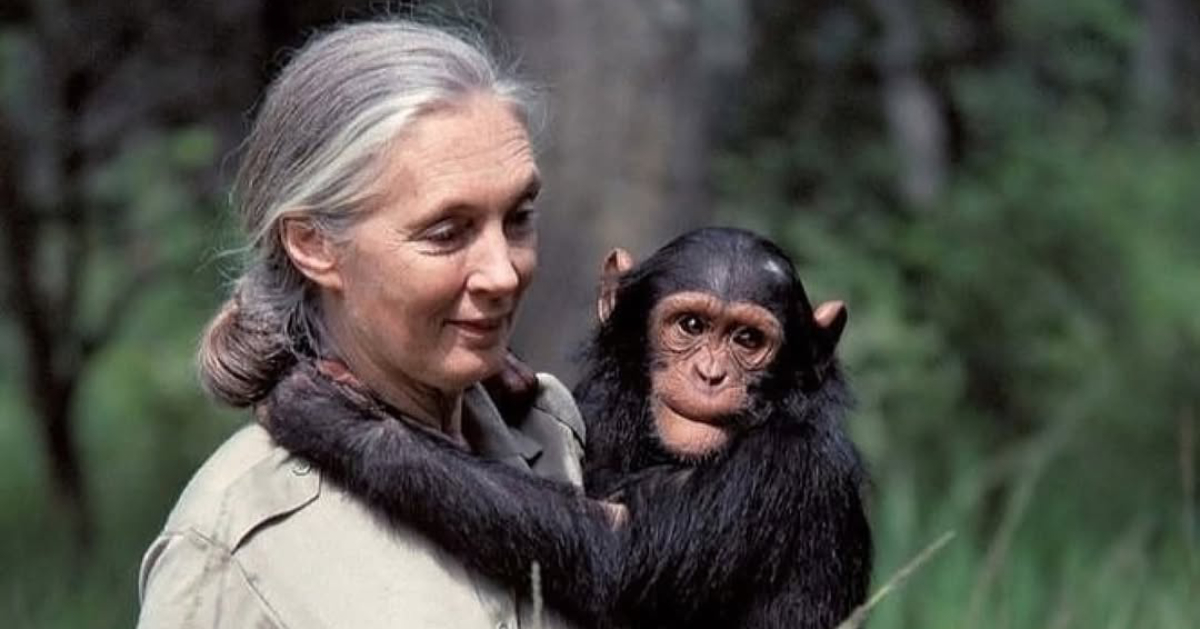
Image source: Dr. Jane Goodall Institute UK
It was 1960, and Jane Goodall was only 26 years old when she left home for Tanzania to learn more about chimpanzees. She spent 65 years in their habitat, living among them as a neighbor rather than a researcher. Jane’s study of chimpanzees in Tanzania remains the longest continuous study of any animal in its natural habitat.
Dr. Jane Goodall was a primatologist, conservationist, animal advocate, educator, and National Geographic explorer. Her work transformed our understanding of the natural world and raised global awareness about conservation.
Sadly, Dr. Jane Goodall passed away on Oct. 1, 2025. In her memory, it’s worth revisiting the National Geographic documentary An Inside Look and appreciating her lifelong dedication as an advocate for animals and the planet.
The Start of a Lifelong Mission in Africa
It all started in 1957, when Dr. Louis Leakey believed that studying chimpanzees could reveal new insights into early human behavior.
Dr. Leakey needed a researcher for a six-month program in Gombe National Park in Tanzania. He was looking for someone open-minded, passionate about animals, patient, and free from the biases of scientific theories.
Jane Goodall was Dr. Leakey’s secretary. She had no scientific background; all she had was a genuine love for animals. That was enough for her to begin her journey in Gombe National Park, Tanzania.
Trusting Her Purpose
It’s interesting that Jane had dreamed of living in Africa, among the animals, since she was 9 years old. Her childhood dream came true when she finally made it there.
The area was full of poisonous snakes, and it was frightening to get close to wild animals. But Jane believed she was meant to be there, so nothing would happen to her.
She had no formal training, and studying chimpanzees required her to get close to them. That wasn’t easy. The chimps would run off the moment they saw her, but she never gave up. She simply trusted her purpose and kept showing up.
It took months of patience and quiet observation before they finally accepted her. Jane was the first human to get truly close to chimpanzees. She even gave them names—David, McGregor, Flo, and Fifi, and others.
What She Discovered About Chimpanzees
What Jane learned through years of observation was that, in many ways, chimpanzees are like humans. The project began with the goal of finding the similarities between the two species.
Here’s what she discovered:
- Chimpanzees need friendly contact and reassurance.
- They have personalities shaped by thought and reasoning.
- They experience emotions such as joy, sorrow, fear, and even jealousy.
- They not only use tools but also modify objects to create them. Jane once observed David, one of the chimpanzees, pick a leafy twig and strip it clean before using it as a tool.
- The bond between a mother and child was full of affection, tolerance, and care. A mother chimp would guide her infant with patience and distraction rather than punishment.
- They experience grief. Jane observed a young chimp who lost her mother, stopped eating, and died three weeks later from what seemed like heartbreak.
- They can also show aggression. Conflicts between groups sometimes led to violence and even killing. Jane’s observations suggested that, just like humans, chimpanzees have a darker side too—something we may share through our genes.
How Jane Changed the World
Dr. Jane Goodall’s lifelong dedication to chimpanzees created a legacy that continues to inspire research, conservation, and education.
- Building a research center: She raised funds to establish a station in Gombe, which now hosts scientists and students conducting advanced studies on chimpanzee behavior.
- Lifelong commitment: Her association with chimpanzees lasted a lifetime, and she continued her work in Gombe even after starting a family.
- Challenging assumptions: Her observations revealed that chimpanzees also use and modify tools, reshaping our understanding of early human behavior.
- Raising awareness: She tirelessly highlighted the declining populations of chimpanzees, encouraging future generations to care for them.
- Educating youth: In 1991, she founded Roots & Shoots through the Jane Goodall Institute to teach young people about conservation and protecting our planet.
What Jane Wanted the World to Know
Dr. Jane Goodall dedicated her life to studying chimpanzees and discovering the similarities they share with humans. She also observed the differences that make humans unique. Our ability to develop spoken language, pass on knowledge, and build complex societies gives us a highly developed intellect.
She believed that with this gift comes responsibility. We have a duty to protect other life forms on our planet, whose survival is threatened by human carelessness. Jane wanted the world to understand that our intelligence is not just for progress but for compassion. She believed that by learning from nature and acting with kindness, we can ensure a future where humans and all living beings thrive together.
About The Author

Sahar Fallah
I'm Sahar, a storyteller who values non-generic stories about life, experiences, self-care,
and awareness. Words have a powerful impact, and I’m here to use them to spread
kindness and share stories worth hearing.
I’m proud to be part of DivsFeed, a platform that celebrates real humanity and highlights
stories that might otherwise go unheard.


reader's monthly pick


subscribe to newsletter
Sign up for The DivsFeed newsletter to get heartwarming stories in your inbox every month.