Watch Out! Your Dog Is Learning New Words
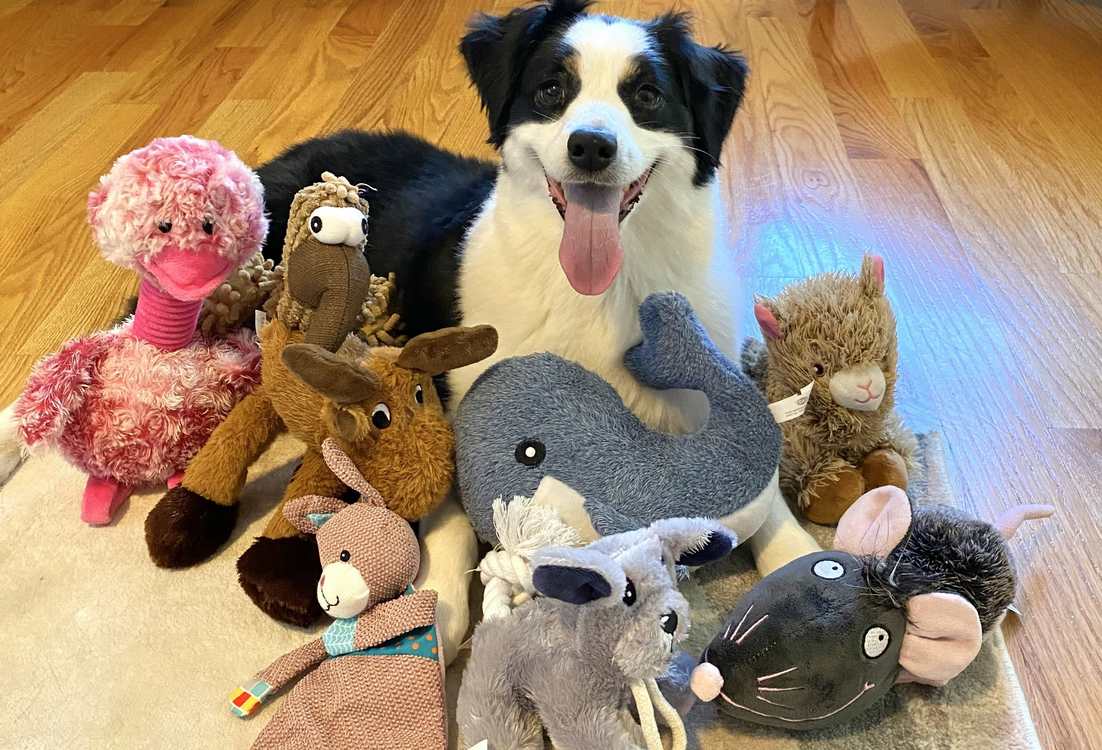
Scientists say that dogs can pick up new words just by listening to their owners speak. A new study has been published in the journal Science about these clever canines.
GWL Dogs
Parents of toddlers are careful with their word choice, and new research suggests dog owners may need to be just as mindful. Scientists are now comparing early childhood language learning to a rare group of highly intelligent dogs.
Gifted Word Learners and Everyday Speech
Parents of toddlers are careful with their word choice. Previous research has shown that toddlers can already learn new words and phrasing by listening to their parents and other speakers at the age of 18 months.
Now scientists are comparing this learning development to dogs, specifically intelligent dogs. This means that a childless dog owner must also be aware of little ears listening in.
I am sure you have heard a friend spell “treat” or “walk” in front of their dog instead of saying the actual words. Not every dog has the ability to learn new words.
It is a trait specifically in GWL, or Gifted Word Learner, dogs. The abstract of the study reads, “In this study, we demonstrated that a small group of Gifted Word Learner dogs, which possess an extensive vocabulary of object labels, can learn new labels by overhearing their owners’ interactions.”
They can quickly learn hundreds of toy names just from play sessions with their owners. Until this research was conducted, researchers were not sure whether these Gifted Word Learner dogs can also learn the names of other objects even when they are not being directly addressed by their owners.
It has been confirmed that children are able to learn in this way “but they must monitor the speakers’ gaze and attention, detect communicative cues, and extract the target words from a continuous stream of speech.”
The lead author of this new study, Dr. Shany Dror explains, “Our findings show that the socio-cognitive processes enabling word learning from overheard speech are not uniquely human. Under the right conditions, some dogs present behaviors strikingly similar to those of young children.”
The Experiment
To better understand how dogs learn through overhearing, researchers designed controlled experiments that mirrored methods used in studies with young children. These tests explored whether dogs could connect words to objects without being directly spoken to.
Testing Direct and Overheard Learning
The study is entitled “Dogs with a large vocabulary of object labels learn new labels by overhearing like 1.5-year-old infants.” The research tested 10 of these gifted dogs in two different situations.
In the first experiment, owners introduced two new toys, labelling them repeatedly while directly interacting with their dog. Then in the second experiment, the dogs simply watched as their owners talked with another person about the new toys.
The owners did not address their dog in any way. In both instances, the dogs heard the names of the new toys for just eight minutes. This time was distributed across multiple, short, sessions.
According to the study, “It began with 1 min of labeling (e.g., ‘This is Toy A’), was followed by 3 min of play with the toy without mentioning the label, and ended with free exploration time, in which the dog could engage with the toy alone (for up 20 min).”
To determine whether or not the dogs had learned the new words for the toys, researchers put the toys in a different room.
In the study, the owner is referred to as (C) and the “partner” is an additional family member. “C used simplistic linguistic frames and ostensive communicative cues, such as gaze alternations between the object and the partner and expressions of enthusiasm.”
“Neither of the owners looked at or communicated with the dog in any way during the labeling phase of the protocol.”
The owners asked their dogs to retrieve each toy using its name. In the very first trials of the test, it was already a success.
The dogs performed well, with 80% correct choices when they were directly addressed and a whopping 100% when they overheard the new words.
To return to the previous comparison between these intelligent dogs and toddlers, the results of the dog experiments mirror results from similar experiments of toddlers.
Similar findings about canine language comprehension have been reported by The Guardian.
Another Experiment
While encouraged by the initial results, the research team wanted to push the limits of what these dogs could do. A second experiment added an extra layer of difficulty to the learning process.
Learning Without Seeing
Though they were pleased with the success of their first experiment, the research team conducted a second one that was more challenging.
In this second experiment, the owners first showed the toys to their dogs and then placed them inside of a bucket. They only named the toys when the dogs could not see them.
The team of researchers explained that “it created a temporal separation between seeing the object and hearing its name.” Most of the GWL dogs were still able to successfully find the named toy.
The Study’s Findings
The researchers believe these results point to broader cognitive abilities shared between species. The findings also highlight just how unusual and specialized Gifted Word Learner dogs are.
What This Means for Dogs and Humans
The study’s authors suggest that the ability to overhear and learn new words may rely on general “socio-cognitive mechanisms” that do not only exist in humans, and instead are shared across species.
They made a point to emphasize that these GWL dogs are extremely rare, and therefore they reflect individual traits and life experiences.
The study talks about the evolution of dogs, “Research shows that dogs display several behaviors analogous to those of young children, evident in very young puppies.”
“Listening to and learning human verbal interactions may have given dogs an evolutionary advantage.”
“These dogs spontaneously acquire object labels without intentional training, during natural play interactions.”
“Thus, Gifted Word Learner dogs may present social cognitive skills for learning object labels from overheard speech.”
About The Author

Aubrey White
Aubrey graduated Summa Cum Laude with a Bachelor’s in English from Montclair State
University. She has always been passionate about reading and writing and hopes to one day
publish her own novel.
Some of her favorite books are The Silent Patient by Alex Michaelides, The Shining by Stephen King, The Midnight Library by Matt Haig, and First Time Caller by B.K. Borison. She loves animals, especially dogs. In her free time, she likes going to the gym, hanging with friends, watching rom-coms with her mom, reading, and writing short stories.




reader's monthly pick


subscribe to newsletter
Sign up for The DivsFeed newsletter to get heartwarming stories in your inbox every month.