
Matthew Shepard: A Life That Sparked More Love

Matthew Shepard in 1998
Source: PBSNews
On the night of October 6, 1998, Matthew Shepard, a then 21-year-old openly gay student at the University of Wyoming, was approached by two men, Aaron McKinney and Russell Henderson, at a bar in Laramie. Both men pretended to be gay and convinced him to get into their truck under the guise of giving him a lift home. Instead, they took him to a remote area, tied him to a fence, and bludgeoned him with the butt of a gun. After robbing him, they left him tied up and unconscious in near-freezing temperatures for approximately 18 hours.
The next morning, a bicyclist discovered Matthew clinging to life, his face bloodied with tears frozen on his cheeks. He was rushed to a hospital in Colorado, where he was in a coma for five days before his death on October 12, 1998.
To understand the impact and significance of this crime, it’s important to know who Matthew Shepard was before that night in October, his upbringing and the life he was working to build for himself.
Early Life and Aspirations
Matthew Shepard was born on December 1, 1976, in Casper, Wyoming. He was the eldest son of Judy and Dennis Shepard, and from a young age, he showed a deep empathy for others. Friends and family described him as thoughtful, curious, and idealistic. He had a passion for politics and human rights, and after attending high school in Switzerland, he returned to Wyoming to study political science at the University of Wyoming. Matthew’s mother described their relationship in her 2009 book, The Meaning of Matthew. “He was my friend, my confidant, my constant reminder of how good life can be.”
As we know now, those ambitions and ideals wouldn’t be fully realized. In October 1998, the optimism that defined Matthew’s life collided with the dark reality that being openly gay could make him a target. What happened at the time of his death, during the trial, and the events following would ignite a national conversation about hate, justice, and mercy.
The Trial
The investigation led to the arrest of both McKinney and Henderson. Evidence found in their truck included Shepard’s shoes, wallet, and credit card. The murder weapon, a .357 Magnum pistol, was also discovered. Both were charged with first-degree murder, kidnapping, and robbery.
During the trial, prosecutors presented a disturbing account of the night in question. McKinney and Henderson had planned to rob Shepard, targeting him specifically because he was gay. The defense attempted to argue that McKinney experienced “gay panic,” a discredited legal defense. The jury did not accept it and convicted both Henderson and McKinney. Henderson was sentenced to life in prison without the possibility parole. McKinney was also sentenced to life in prison after the Shepards intervened to dissuade the judge from sentencing him to death.
Dennis Shepard addressed the court during McKinney’s sentencing. “I would like nothing better than to see you die, Mr. McKinney. However, this is the time to begin the healing process… I am going to grant you life, as hard as it is for me to do so, because I believe in mercy.”
Statistics & Violence Against LGBTQ+ People
27 years after Matthew’s murder, LGBTQIA+ people are still at significant risk of being victimized. The violence targeting LGBTQ+ individuals have escalated in frequency and severity across the U.S. According to the FBI’s Uniform Crime Reporting Program, hate crimes related to sexual orientation and gender identity accounted for more than 21% of all hate crimes in 2023, with 2,402 incidents related to sexual orientation and 547 related to gender identity. This highlights the increase in violence towards this community.
In 2024, these categories remained among the top three most reported motivations for hate crimes nationwide, with attacks based on sexual orientation comprising 17.2% and those based on gender identity 3.9% of all hate crimes.
The Human Rights Campaign notes anti-LGBTQ+ hate crimes have continued to spike even as overall violent crime rates have declined, underscoring a disturbing trend: LGBTQ+ people are increasingly targeted for violence, particularly transgender and gender non-conforming individuals.
It’s worth noting underreporting remains a significant barrier to accurate reporting. Many survivors don’t report incidents due to fear or lack of trust in law enforcement, suggesting the true scale of violence may be higher than these figures indicate.
The Matthew Shepard Foundation
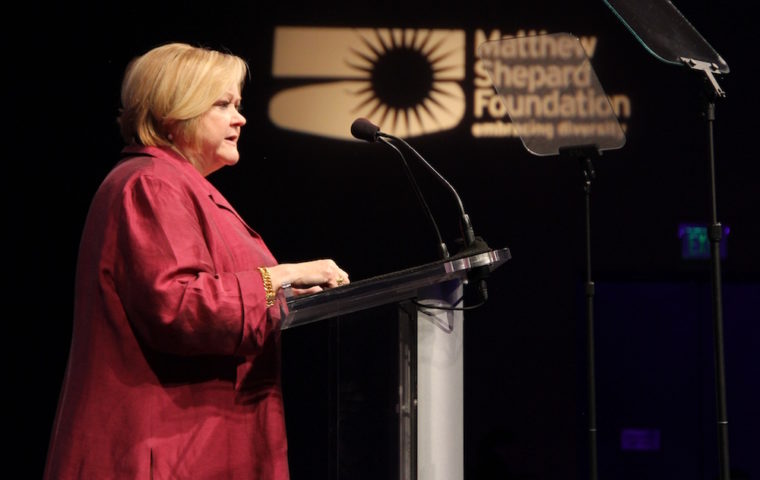
Judy Shepard speaking at a Foundation event in 2015
Source: MatthewShepardFoundation
In the months following Matthew’s death, the Shepards founded the Matthew Shepard Foundation. The organization’s mission is to “eradicate hate” through education, outreach, and advocacy. It has trained law enforcement on hate crime prevention, supported LGBTQ+ youth, and helped communities confront bias.
Jason Marsden, the Foundation’s former executive director, said the goal is to “change hearts and minds about the importance of respect for diversity, of inclusion, of understanding for LGBTQ people everywhere so that they are less subject to violence and more welcome in the circle of society.” As Judy Shepard said, “We lost Matt, but we were welcomed into a whole new family. We didn’t know we had all those gay kids out there. They’ve been pretty amazing to us.”
The Foundation’s advocacy contributed to a major legislative victory. In 2009, Congress passed the Matthew Shepard and James Byrd Jr. Hate Crimes Prevention Act The law expanded federal hate crime statutes to include crimes motivated by sexual orientation, gender identity, and disability. It also provided funding and support for local jurisdictions to investigate and prosecute hate crimes.
The Laramie Project

Source: TheLaramieProject
One of the most enduring cultural responses to Matthew Shepard’s murder is The Laramie Project, a play created by Moisés Kaufman and members of the Tectonic Theater Project. The group traveled to Laramie shortly after the murder and conducted hundreds of interviews with residents. The result was a documentary-style play that explores the town’s reaction to the crime and the broader social context of homophobia in America.
Premiering in 2000, the play has been performed in thousands of venues across the U.S. and internationally. It has become a popular show to perform in high school and college theater programs, often sparking community dialogue about tolerance and justice. In 2002, HBO adapted the play into a film, bringing the story to a wider audience.
A Final Resting Place
In 2018, Matthew’s ashes were interred at the Washington National Cathedral. His parents had delayed choosing a final resting place, due to concerns about vandalism. The Cathedral offered safety and symbolism. The invitation to bury Matthew at the Cathedral came from Bishop Mariann Edgar Budde, the Episcopal Bishop of Washington. She extended the offer, recognizing the significance of Matthew’s story to the LGBTQ+ community and the nation at large.
The Shepards accepted and more than 2,000 people attended the service. “Matt loved the church,” Dennis Shepard said during the ceremony. “It is so important we now have a home for Matt. A home that others can visit. A home that is safe from haters.”
A Legacy of Action
Organizations like the Matthew Shepard Foundation, The Trevor Project, and GLAAD have empowered communities, educated the public, and fought for equality. Schools and workplaces increasingly embrace inclusive policies. Furthermore, cultural representation of LGBTQIA+ people in media has helped to normalize diverse identities and foster empathy.
Though significant challenges remain, every Pride march, inclusive classroom, and supportive family reflects a world moving closer to one Matthew envisioned; a world where authenticity is celebrated.
The most important legacy of his life may be one that lives in decisions people make, how they treat others, and how they respond to injustice. The Shepards’ decision to spare their son’s killers, their creation of a foundation, their advocacy for federal legislation have changed lives. As Judy Shepard once said “We can’t erase hate, but we can make sure it doesn’t win.”
About The Author

Matthew DiGiandomenico
Matt worked for over a decade in the mental health field, committed to helping others through complex challenges. As a writer, he is driven by that same commitment to help others through
writing on topics including mental health and open adoption.
Matt holds a Master’s Degree in Psychology from Fairleigh Dickinson University and an Advanced Professional Writing Certificate from the University of Pennsylvania. He lives in Philadelphia with his husband and 2 young kids.




reader's monthly pick


subscribe to newsletter
Sign up for The DivsFeed newsletter to get heartwarming stories in your inbox every month.