Love All, Share All: How Sikh Volunteers Australia Brings Humanity To Disaster Zones
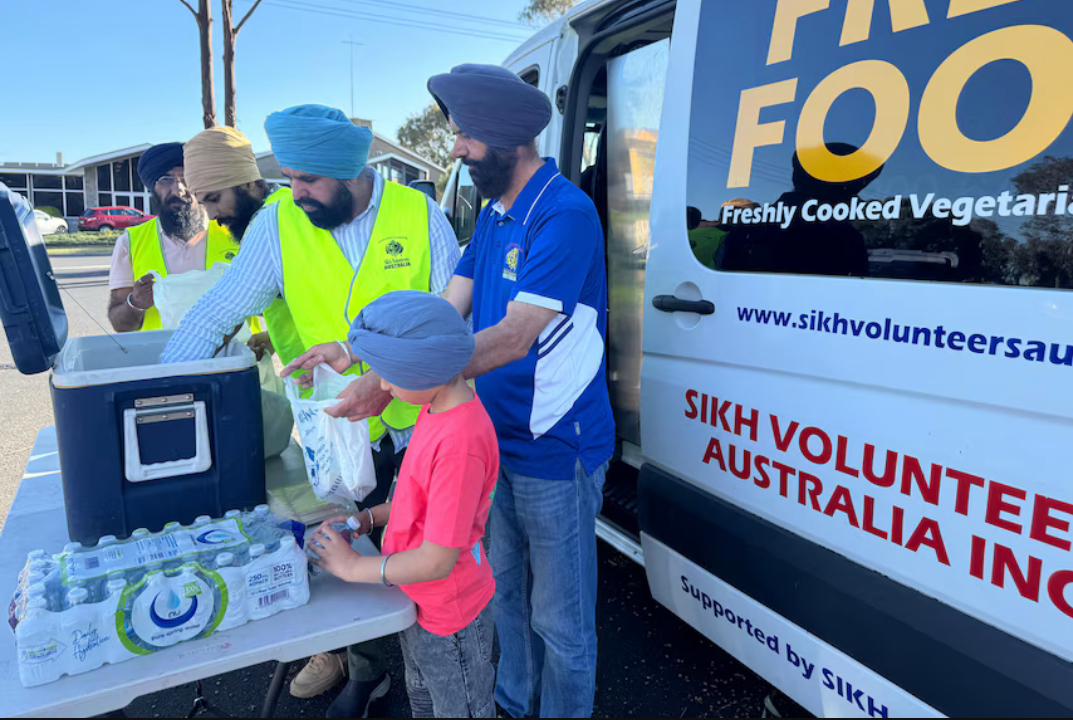
In the wake of Australia’s 2025 floods, Sikh Volunteers Australia once again turned compassion into action — traveling over 1,000 km to feed stranded families. Their story is a testament to how quiet, consistent kindness can hold a community together.
Photo Credit: Lexie Jeuniewix
When torrential rains swept across New South Wales in May 2025, roads turned into rivers and hundreds of homes were left stranded. For many residents in small rural towns, help felt heartbreakingly far away. The power was out, supplies were low, and even emergency services struggled to reach the worst-hit areas.
Then, one morning, a brightly colored food truck rolled into Taree — a farming community nearly 1,200 kilometers from Melbourne. The team inside wore cheerful blue turbans and yellow aprons. Within minutes, the air filled with the scent of steaming rice, lentils, and curry. The words printed across the side of the truck read: “Love All, Share All.”
They were the Sikh Volunteers Australia (SVA) — a small charity with an extraordinary heart. For nearly a decade, SVA has been serving free vegetarian meals to people affected by disasters across Australia. They don’t ask about religion, background, or nationality. They just cook. And when the floods came, they came too.
“We do it because we are human,” said SVA co-founder Amar Singh, in an interview with Reuters. “When someone is hungry or in pain, we don’t see strangers — we see family.”
A Tradition of Seva
This work comes from a long practice: seva, or selfless service. It’s where free community kitchens begin — and why a food truck becomes a lifeline after floods.
Roots and Road Kitchens
The idea behind SVA is rooted in the Sikh principle of seva — selfless service to others. In Sikhism, feeding the hungry and serving communities is not charity; it’s duty. Every gurdwara (Sikh temple) in the world operates a langar, or free kitchen, open to anyone who walks in.
In 2017, a group of Melbourne Sikhs decided to take that spirit on the road. They bought a van, fitted it with cooking equipment, and began serving meals in times of crisis. Since then, they’ve traveled thousands of kilometers — to bushfire zones in Victoria, flood-hit towns in Queensland, and even to city streets where people face hunger every day.
Learn more about the organization behind the meals at Sikh Volunteers Australia. For reflections on everyday generosity, see The Science of Kindness.
The Floods in Taree
When power is out and roads are gone, a hot meal can feel like a bridge back to normal life. In Taree, that bridge arrived on wheels.
First Hot Meals in Days
When floods swept through the Manning River region in 2025, entire communities were cut off. One of the local dairy farmers, Mark Kappa, told Reuters that the food truck brought the first hot meal he and his neighbors had seen in three days.
“We had no power, no supplies, no way to get out,” he said. “Then these guys showed up and handed me a cup of tea. I can’t tell you what that meant.”
SVA’s volunteers prepared nearly 3,000 hot vegetarian meals over several days — lentil curry, rice, and vegetable pasta — cooked from scratch in their mobile kitchen. They also delivered food to elderly residents who couldn’t leave their homes.
“It’s not just about food,” said volunteer Harpreet Kaur, speaking to ABC News Australia. “It’s about reminding people that they’re not forgotten. That someone sees them.” For the flood response overview, read Reuters’ coverage. For simple, steady practices of self-care during crisis, visit 10 Simple Ways to Practice Self-Kindness.
Kindness as a Kind of Logistics
Behind every plate is a plan: long drives, safety checks, and quiet collaboration — all so a neighborhood can eat together again.
Coordination on the Move
The work looks simple, but it requires extraordinary coordination. SVA’s volunteers — many of whom have full-time jobs — drive long distances after work, often sleeping in their vans. They organize supplies, maintain health safety standards, and collaborate with local councils and police. Their meals are vegetarian, not only for inclusivity across faiths and diets but also for practical reasons — they can be stored and served safely in remote conditions.
“When disaster strikes, people lose not only homes but also their sense of dignity,” says Singh. “Food restores that dignity. A warm meal says, ‘You still matter.”
Explore more stories of quiet courage on Self-Kindness & Personal Growth.
The Ripple Effect of One Hot Meal
Kindness compounds. Each time a truck arrives, it leaves more than food — it leaves a memory that invites others to act.
From Firegrounds to Floodplains
The story of Sikh Volunteers Australia isn’t just about disaster relief; it’s about how consistent kindness builds resilience in communities. Each time they arrive, they leave behind more than food. They leave behind a memory of compassion that spreads quietly, person to person.
Residents in Victoria still talk about how SVA showed up during the Black Summer bushfires of 2019–2020, serving firefighters and evacuees for weeks without asking for payment or praise. Many locals have since volunteered or donated to the group, inspired by their example.
Kindness, as researchers like Dr. Jamil Zaki (author of The War for Kindness), note, grows stronger through repetition. It becomes a habit — a muscle we train each time we act. SVA’s story is that truth in motion. For a research-based perspective on how helping others boosts well-being, see the American Psychological Association. You can also browse recent uplifting pieces on The DivsFeed Blog.
Not About Religion, But Humanity
The message is simple and wide: no preaching, just service — a familiar truck, a warm plate, a shared moment.
Service Without Barriers
Although the group’s work comes from Sikh teachings, their message transcends faith. “We don’t preach. We serve,” Singh told Reuters. Their food trucks have become familiar sights at natural disaster zones, often arriving before larger organizations.
It’s a kind of quiet heroism — not dramatic, but deeply human. Each meal cooked and handed over bridges the distance between strangers. It proves that compassion isn’t a luxury; it’s a form of infrastructure, holding communities together when everything else falls apart.
Lessons in Everyday Seva
Most of us won’t drive 1,000 kilometers with a kitchen, but we can still practice the same spirit — in small, local, durable ways.
What We Can Share
There’s something profoundly grounding about SVA’s model of kindness. They don’t frame their work as saving others. They see it as sharing life — a simple exchange of food, presence, and dignity. And that’s what makes their example so universally resonant.
Because while few of us may have a food truck or thousands of meals to give, we all have something that someone else needs — a moment, a check-in, a hand. The world doesn’t always change through grand gestures.
Sometimes it changes through lentils and rice, offered with sincerity.
About The Author

Ada Maidoh
Ada writes with a soft spot for ordinary moments, the kind most people overlook. She’s spent years helping others find the right words, and somewhere along the way, found her own. When she’s not writing, you’ll probably find her people-watching, making tea, or rewriting the same sentence five times just to get the rhythm right.



reader's monthly pick


subscribe to newsletter
Sign up for The DivsFeed newsletter to get heartwarming stories in your inbox every month.